Query “Singapore dollar” was recorded active on Google Trends Indonesia in the morning of 22 October 2026. When checked, the query exceeded 5,000 searches and rose about 400% above its normal level.
Google Trends data shows a change in search interest, not its cause.
The rise is also not evidence that the Singapore dollar will move in a particular direction.
This article does not provide currency forecasts, investment recommendations, or advice to buy or sell currency.
For businesses, attention to SGD can translate into concrete operational issues.
A company may receive invoices from Singapore vendors, sell services to overseas customers, pay digital licenses, calculate travel costs, or prepare reports involving more than one currency.
In such conditions, the problem is not just finding an exchange rate.
The business system must answer: where the rate comes from, when it applies, what costs are added, who approves, and how the result is reconciled?
Why the Exchange Rate on the Screen Is Not Yet a Transaction Cost
Bank Indonesia provides BI Transaction Rates in the form of selling and buying foreign exchange rates against the rupiah.
BI explains that this information is used as a reference for BI transactions with third parties and is announced once each business day at 08:00 WIB.
BI also provides Non‑USD/IDR Reference Rates that include SGD.
However, the reference rate is not automatically the final price offered by banks, payment providers, cards, marketplaces, or foreign exchange exchanges.
The Monetary Authority of Singapore explains that the displayed rate is the average interbank buying and selling rate around noon in Singapore.
The page also states that the value may differ from foreign exchange dealer rates.
Differences can arise from data capture time, spread, transfer fees, administrative fees, provider markup, payment method, transaction volume, settlement time, and each service’s policy.
Therefore, the business system must distinguish three things:
- Reference rate, for analysis, recording, or comparison.
- Offer rate, provided by the provider for a specific transaction.
- Effective rate, the actual rupiah cost after all fees are considered.
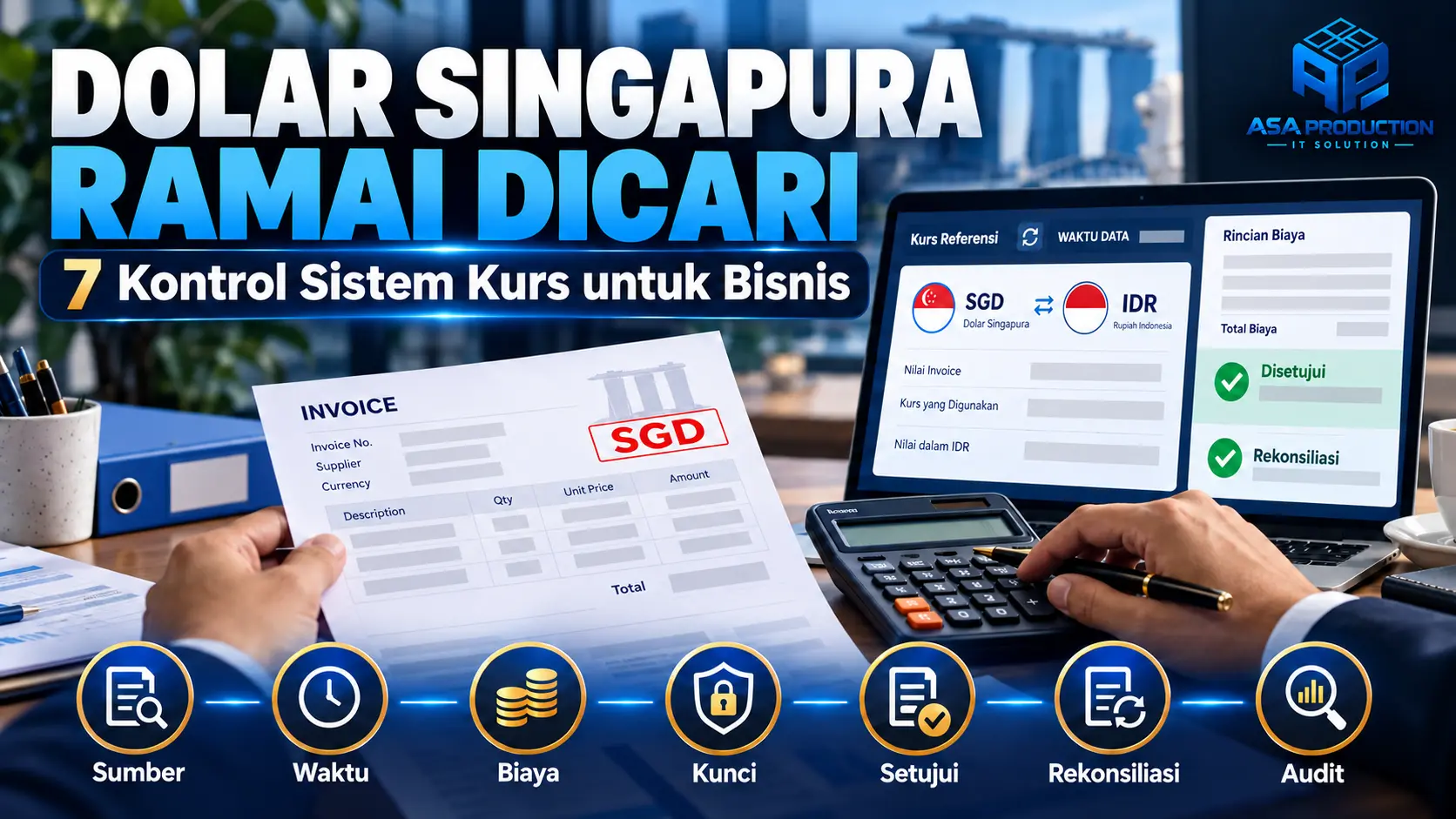
7 System Rate Controls for Business
1. Source: Set a Rate Source for Each Purpose
Do not use a single rate for all processes without rules.
Define the source based on its intended use.
Examples:
- official reference rate for dashboards or analysis;
- provider offer rate for payment estimates;
- rate agreed in a contract for a specific invoice;
- actual settlement rate for reconciliation;
- company accounting policy for recording reports.
Store the source name, rate type, currency pair, and retrieval method.
If the source comes from an automatic integration, document the endpoint, version, update schedule, and behavior when the service is unavailable.
Bank Indonesia provides a directory of payment system operators and foreign exchange business activities along with their licensing status. When choosing a provider, businesses must verify the latest identity and status through official channels, not just logos or circulating promotions.
Minimum control: every rate value in the system has a source label and intended use.
Users should not see a number without knowing whether it is a reference, offer, or settlement result.
2. Time: Store Timestamp and Validity Period
Rate is time-bound data.
A number without a timestamp can mislead, especially when an invoice is created, approved, and paid on different days.
Store at least:
- time the data was published by the source;
- time the system retrieved the data;
- time zone;
- validity period;
- time the user selected or locked the rate;
- time the transaction was settled.
Show the timestamp near the rate value, not hidden in a technical page.
If the data has expired, mark it as stale and request an update before proceeding with the transaction.
The system should also have a policy for weekends, holidays, or integration failures.
Options may include using the last rate with a clear label, holding the transaction, or requesting manual verification.
That decision must follow the company’s needs, contracts, and financial policy.
Minimum control: no transaction uses a rate without a date, time, time zone, and validity status.
3. Cost: Separate Rate, Spread, and Additional Fees
Showing a single conversion number without details can cause users to misjudge total cost.
The system should separate:
- invoice amount in SGD;
- rate used;
- base amount in IDR;
- spread or markup if identifiable;
- transfer fee;
- administrative fee;
- intermediary or correspondent fee;
- tax or other applicable components;
- estimated total and actual total.
Use the term “estimate” if the cost is not final.
Do not hide costs within the rate without explanation if the business requires internal transparency.
To compare providers, calculate the effective rate:
Effective rate = total rupiah paid ÷ amount of SGD received or settled
This formula helps see the real cost, but the result still needs to be read with the transaction time, payment method, and cost scope.
Minimum control: users can see the difference between the base conversion value and total cost before giving approval.
4. Key: Define When a Rate Can Be Locked
An invoice can be created today but paid several days later.
If the system has no locking rule, finance, vendors, and customers may use different numbers.
Define an appropriate mechanism:
- rate follows the invoice issuance time;
- rate follows the invoice approval time;
- rate follows the payment time;
- rate locked via provider offer for a certain period;
- rate difference recorded at settlement.
If the rate is locked, store the offer ID, provider, value, start time, expiration time, user who locked it, and related transaction.
Do not label a rate “locked” if the system merely copies a reference number into a form.
Locking must be based on a verifiable procedural basis or offer.Minimum control: a change in the exchange rate after approval creates a new version, rather than overwriting the old value without a trail.
5. Approve: Implement Limits and Segregation of Duties
Cross‑currency transactions can pose greater risk when the amount is high, the destination account is new, fees deviate, or the rate is far from the reference.
Create approval rules based on factors such as:
- transaction value;
- difference from the reference rate;
- new provider;
- new destination account;
- changes after approval;
- transactions outside normal hours;
- unusual additional fees.
Separate the parties that enter the invoice, select the rate, approve, and execute the payment if the business scale allows. For small businesses, at least use a re‑check by the owner or another responsible person on high‑risk transactions.
The system must reject self‑approval in certain scenarios, log the exception reason, and send an alert when the threshold is exceeded.
Minimum control: every approval records the identity, time, approved value, rate, total cost, and decision notes.
6. Reconciliation: Match Estimates with Settlement Results
The estimated value before payment can differ from the bank mutation or settlement result.
Reconciliation is required so that the difference does not hide as “other fees”.Match:
- original invoice;
- SGD value;
- reference rate;
- offer rate;
- settlement rate;
- provider fee;
- IDR value in the mutation;
- transaction date and value date;
- refund, correction, or partial payment.
Set a tolerance for the difference. Values below a certain limit can be flagged automatically, while large deviations enter a review queue.
Do not force the system to close reconciliation by altering the original invoice.
Record adjustments as separate events so the history can be traced.
Minimum control: a transaction is not considered finished until the invoice value, payment, fees, and mutation can be explained.
7. Audit: Store Data and Decision Trails
An audit trail helps the business answer who did what, when, from which source, and why a value changed.
Record at least:
- currency pair and original value;
- rate source;
- timestamp;
- rate type;
- value before and after change;
- fee;
- invoice or transaction ID;
- submitter and approver;
- reason for change;
- settlement result;
- reconciliation status.
Do not log passwords, access tokens, card data, or sensitive information.
Restrict audit trail access, protect against unauthorized changes, and set retention according to business needs and applicable obligations.
Use consistent currency codes.
ISO 4217 defines a three‑letter alphabetic code and numeric code for currencies, designed for trade, business, banking, and automated systems.
Using codes such as SGD and IDR reduces ambiguity compared to free labels.Minimum control: every significant change can be reconstructed without relying on memory or private chat.
Example Flow: SGD Invoice to IDR
Imagine an Indonesian company receives a vendor invoice in SGD.
A controlled flow can proceed as follows:
- Staff enters the amount and selects the SGD currency code.
- The system fetches the reference rate with source and timestamp.
- The payment provider gives an offer and fee details.
- The system calculates the IDR estimate and effective rate.
- The offer has a visible expiry.
- The transaction is sent for approval according to the threshold.
- After payment, the mutation and settlement result are imported.
- The system calculates the difference and actual fee.
- Reconciliation is closed or forwarded for review.
- All changes are stored in the audit trail.
This flow does not guarantee the best rate. The goal is to make consistent, transparent, and auditable decisions.
30‑Day Implementation Plan
Week 1: Inventory
List all processes that use foreign currencies: purchases, sales, travel expenses, software subscriptions, reimbursements, and reporting. Record the current rate sources.
Week 2: Standardization
Define objectives for each source, currency code format, timestamp, validity period, rounding rules, cost components, and handling of expired data.
Week 3: Approval and Reconciliation
Build approval thresholds, segregation of duties, difference tolerance, and review workflow. Test with anonymised historical transactions.
Week 4: Integration and Audit
Connect data sources, invoices, payments, and reports. Enable change logs, integration failure alerts, and a dashboard for unreconciled transactions.
Minimum Exchange Rate Dashboard
The initial dashboard can display:
- currency pair;
- rate source and type;
- timestamp and validity status;
- invoice value;
- IDR estimate;
- fee details;
- effective rate;
- approval status;
- offer expiry time;
- settlement result;
- difference;
- reconciliation status.
Visually separate reference, estimate, and actual figures. Users should understand the number status without opening technical notes.
Common Mistakes to Avoid
- Pulling rates from search results without source and timestamp.
- Assuming the reference rate is the final transaction price.
- Hiding fees within the conversion figure.
- Overwriting old rates without version and reason.
- Allowing one person to create, approve, and pay large transactions.
- Ignoring weekends, holidays, and integration failures.
- Closing reconciliation by altering the original invoice.
- Storing tokens or sensitive data in the audit trail.
- Creating automatic rate predictions without a model, usage limits, and proper governance.
From Rate Trends to a Trustworthy System
The surge in Singapore dollar searches shows focus on SGD, but businesses do not need to respond with speculation.
Focus on the systems within your control: data sources, time, cost, locking, approvals, reconciliation, and audit.Asa Production helps businesses build websites, applications, financial dashboards, API integrations, approval workflows, notifications, AI, and automation that link invoices to transactions and reporting.
CTA: If cross‑currency exchange rates and payments are still scattered across spreadsheets, chats, and manual inputs, discuss a suitable dashboard design and automation through www.asaproduction.tech.
Asa Production — Build. Automate. Grow.
Note: This article is educational and not financial, investment, tax, accounting, or legal advice. Exchange rates and licensing status may change. Verify the latest data with Bank Indonesia, official providers, contracts, and competent professionals.