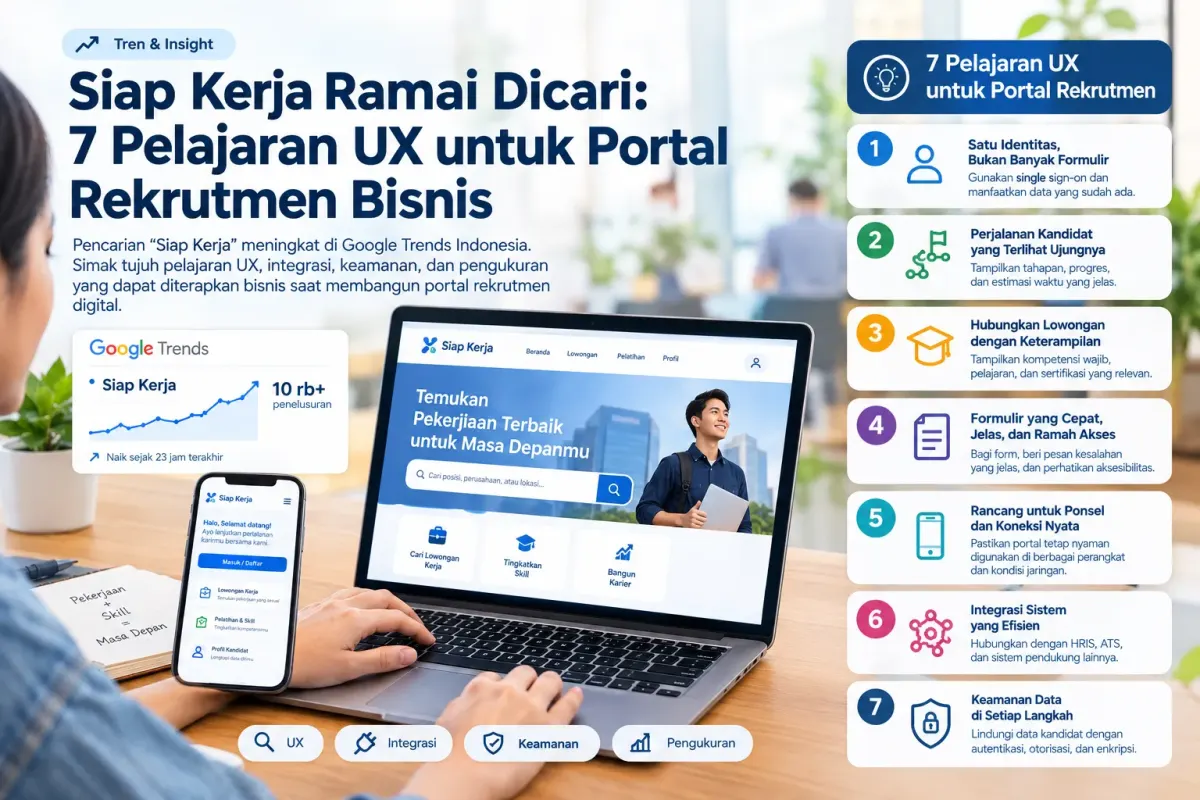
Search “Siap Kerja” has entered the list of trending queries on Google Trends Indonesia on the morning of October 27, 2026. In the 24‑hour view, Google recorded that the query cluster had 10k+ searches, remains active, and began rising about 23 hours earlier. That figure is the volume shown in the Google Trends range, not the number of unique users or a direct measure of market demand.
This momentum is attractive to businesses not only because people are searching for employment services. There is a larger product lesson: users need a clear digital journey—creating an account, completing a profile, finding opportunities, upskilling, and then following up on the results.
SIAPKerja is defined in the Ministry of Manpower Regulation No. 17 of 2024 as a digital ecosystem that integrates national employment services. The ecosystem includes services such as Karirhub for job opportunities and Skillhub for training. This does not mean every company must copy the government platform. However, the user journey patterns provide relevant inspiration for career portals, recruitment systems, or internal company apps.
Why the “Siap Kerja” Trend Matters for Business?
When search interest in employment services rises, one signal worth noting is that job seekers are actively looking for an easy‑to‑understand entry point. For companies, the question is not just “where to post a vacancy?” but “how easily can the right candidate find, understand, and complete our process?”
A good recruitment portal should reduce manual work on both sides. Candidates should not have to repeatedly fill in the same data. HR teams should not have to transfer information from forms, emails, spreadsheets, and instant messages one by one. Management can also view recruitment status through consistent data.
Here is where UX, system integration, automation, and security converge.
Lesson 1: Start with One Identity, Not Many Forms
One account reduces friction
The Ministry of Manpower help center explains that SIAPKerja uses a single sign‑on mechanism so one account can access multiple connected services. For businesses, the principle is simple: don’t ask candidates to create an account or enter new identity at every stage if the same data is already available.
A single candidate profile can serve as the data source for applications, assessments, interview schedules, offers, and onboarding.
If an organization has multiple brands or branches, a consistent identity also helps prevent duplicate profiles.
Still provide a proportional path
Not every vacancy requires a full account from the start. Candidates should be able to read job descriptions without registration. A new account is needed when users want to save progress or submit data. Thus, friction only appears when truly necessary.
Lesson 2: Build a Candidate Journey with a Clear End
Applicants often stop because they don’t know how long the process will take or what happens after they click “Submit”. A recruitment portal should display concrete stages:
- selecting a position;
- completing a profile;
- uploading documents;
- taking assessments if required;
- monitoring selection status.
Use progress indicators and realistic time estimates. After the application is sent, show a reference number, data summary, help channel, and expected next steps. This transparency can reduce repeated questions to HR.
Lesson 3: Link Vacancies to Skills
SIAPKerja connects job search services with training in one ecosystem. Skillhub, for example, becomes the gateway to various vocational training programs. A business can adapt the idea by turning vacancies from passive requirement lists into competency maps.
Differentiate mandatory requirements from learnable skills
For each position, display:
- mandatory competencies before applying;
- skills that can be learned after joining;
- relevant certifications;
- examples of expected work or portfolio.
If a candidate is not suitable for one position, the system can recommend other vacancies or preparatory material. For large companies, a similar approach can be used for internal mobility.
Lesson 4: Create Fast, Clear, and Accessible Forms
Recruitment forms are often the main failure point. Candidates may use mobile phones, unstable connections, or assistive technology. Therefore, forms should be split into short sections, savable as drafts, and should not lose data when errors occur.
W3C emphasizes that detected input errors must be identified and explained in text. Messages like “An error occurred” are not enough. Show the problematic field and how to fix it, e.g., “Maximum CV size 5 MB”.
Also check that every column has a label, tab order can be used via keyboard, text contrast is adequate, and buttons are large enough. Accessibility is not a cosmetic add‑on; it helps more candidates complete the process.
Lesson 5: Design for Mobile and Real‑World Connections
Recruitment portals must be tested under conditions users actually experience, not just office laptops with fast Wi‑Fi. Prioritize lightweight page sizes, image compression, progressive loading, and resumable document uploads after a connection drop.
Core Web Vitals assess three aspects of experience: the speed of main content appearance via Largest Contentful Paint, interaction response via Interaction to Next Paint, and layout stability via Cumulative Layout Shift. These metrics do not replace user research but are useful as indicators of technical issues.
Measure the job list page, job detail page, application form, and status page separately. An overall average can hide one step that is very slow.
Lesson 6: Automate the Process, but Keep Human Control
Automation is most useful when it reduces repetitive work. Sistem dapat membantu:
- mengirim konfirmasi lamaran;
- menandai dokumen yang belum lengkap;
- menjadwalkan wawancara berdasarkan slot tim;
- mengingatkan kandidat sebelum asesmen;
- menyinkronkan status ke dashboard HR;
- membuat laporan sumber kandidat dan waktu proses.
Jika AI digunakan untuk merangkum CV atau membantu pencarian kandidat, hasilnya perlu diperlakukan sebagai masukan, bukan keputusan final. Tetapkan kriteria yang dapat dijelaskan, lakukan pemeriksaan bias, batasi data yang diproses, dan pertahankan peninjauan manusia untuk keputusan penting.
Otomasi juga perlu memiliki jalur eskalasi. Kandidat harus mengetahui ke mana meminta bantuan ketika akun terkunci, dokumen gagal diunggah, atau status tidak berubah.
Pelajaran 7: Jaga Keamanan Data Kandidat Sejak Desain Awal
Data rekrutmen dapat berisi identitas, riwayat pekerjaan, dokumen, dan informasi kontak. Jangan mengumpulkan lebih banyak data daripada yang diperlukan. Tentukan siapa yang boleh melihatnya, berapa lama data disimpan, dan bagaimana kandidat dapat memperbaruinya.
Untuk akun HR dan administrator, aktifkan autentikasi multifaktor serta pencatatan aktivitas. OWASP merekomendasikan pemantauan aktivitas autentikasi dan sesi yang tidak wajar, terutama pada peristiwa berisiko seperti pemulihan akun atau perubahan metode autentikasi.
Terapkan pula pembatasan percobaan login, rotasi sesi setelah masuk, enkripsi saat transit, dan pengujian keamanan sebelum peluncuran.
Arsitektur Minimum Portal Rekrutmen
1. Halaman karier
Menampilkan posisi, lokasi, tipe kerja, kompetensi, deskripsi, dan tombol lamaran yang jelas.
2. Profil kandidat
Menyimpan identitas, pengalaman, keterampilan, portofolio, dan preferensi komunikasi tanpa meminta pengisian berulang.
3. Alur lamaran
Mencakup formulir bertahap, unggahan dokumen, validasi, simpan draf, dan konfirmasi pengiriman.
4. Dashboard HR
Menampilkan antrean kandidat, status seleksi, catatan internal, jadwal, dan histori perubahan berdasarkan hak akses.
5. Integrasi dan analitik
Menghubungkan email, kalender, aplikasi pesan, sistem HR, dan laporan operasional melalui API atau otomasi yang aman.
Mulailah berdasarkan masalah terbesar. Jika HR paling banyak kehilangan waktu untuk penjadwalan, integrasi kalender mungkin lebih bernilai daripada fitur AI yang kompleks. Jika kandidat sering gagal mengunggah CV, perbaiki formulir terlebih dahulu.
KPI yang Perlu Diukur
Setelah menetapkan baseline, pantau:
- rasio pengunjung yang memulai lamaran;
- rasio penyelesaian formulir;
- titik pengabaian pada setiap langkah;
- waktu menyelesaikan lamaran;
- jumlah tiket bantuan per 100 pelamar;
- waktu dari lamaran ke kontak pertama;
- waktu pengisian posisi;
- persentase profil kandidat duplikat;
- LCP, INP, dan CLS pada perangkat seluler;
- kepuasan kandidat setelah proses.
Jangan membaca satu angka sendirian. Rasio penyelesaian tinggi belum tentu baik jika formulir terlalu dangkal dan menghasilkan banyak kandidat yang tidak relevan.
Rencana Implementasi 30 Hari
Minggu 1: Petakan perjalanan
Wawancarai HR dan beberapa kandidat. Catat langkah, data yang diminta, aplikasi yang digunakan, waktu tunggu, dan titik kegagalan.
Minggu 2: Buat prototipe
Rancang halaman lowongan, profil, formulir, dan status. Uji di ponsel bersama pengguna yang mewakili kandidat sebenarnya.
Minggu 3: Bangun modul prioritas
Implementasikan fitur dengan dampak tertinggi, termasuk validasi formulir, simpan draf, notifikasi, serta kontrol akses dasar.
Minggu 4: Uji dan luncurkan terbatas
Lakukan pengujian fungsional, aksesibilitas, performa, dan keamanan. Mulai dari satu divisi atau beberapa posisi, ukur hasilnya, lalu lakukan perbaikan sebelum ekspansi.
Kesimpulan: Dari Tren Pencarian ke Sistem yang Berguna
Naiknya pencarian “Siap Kerja” adalah konteks editorial, bukan bukti bahwa semua perusahaan harus membangun platform serupa. Pelajaran yang relevan adalah pentingnya satu identitas, perjalanan yang terlihat, hubungan antara peluang dan keterampilan, formulir inklusif, performa seluler, otomasi yang bertanggung jawab, serta keamanan data.
Portal rekrutmen terbaik bukan yang memiliki fitur paling banyak. Ia adalah sistem yang membuat kandidat memahami tindakan berikutnya dan membantu HR bekerja tanpa administrasi berulang.
Ingin membangun portal rekrutmen atau otomasi HR yang sesuai proses bisnis Anda?
Asa Production membantu bisnis merancang dan mengembangkan website, aplikasi, integrasi API, sistem internal, AI, dan otomasi—mulai dari pemetaan kebutuhan hingga implementasi bertahap.
Kunjungi www.asaproduction.tech untuk mendiskusikan portal karier, dashboard HR, atau alur rekrutmen digital yang aman dan terukur.
Build. Automate. Grow.